EU Sovereign Cloud: Building AI Apps on Scaleway vs. Azure
A pragmatic comparison of deploying modern AI stacks on European sovereign cloud vs. Big Tech. Is the 60% cost saving worth the trade-off?
As developers, we have a massive bias. When we think "Cloud," we default to the Big 3: AWS, Azure, or GCP. It's the safe choice. nobody gets fired for choosing Azure, right?
But for European startups and heavy R&D projects, this default choice comes with a heavy price tag - both in euros and in data sovereignty.
In building our AI Shopping Assistant, we ran a comparative experiment: deploying the same "Modern AI Stack" (Next.js, Python FastAPI, Vector DB) on Azure vs. Scaleway (a French cloud provider).
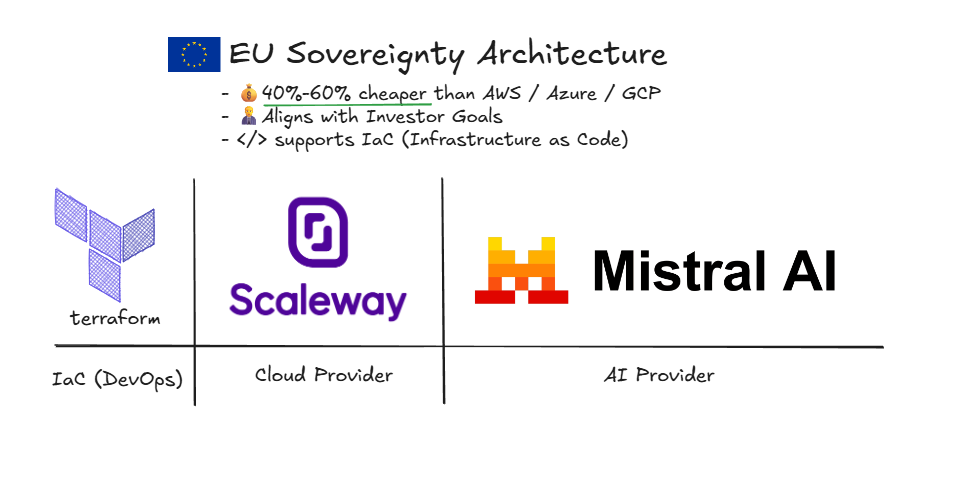
The Comparison: Azure vs. Scaleway
We compared them on three axes critical for modern engineering: Compute Abstractions, AI Services, and Infrastructure as Code (IaC).
1. Compute: Container Apps
Azure Container Apps is a fantastic product. It's serverless Kubernetes (KEDA-based) that just works.
- Pros: Deep integration with GitHub Actions, rapid scaling, zero maintenance.
- Cons: Expensive. The idle cost for a secure vNet-integrated environment is significant.
Scaleway Serverless Containers is their answer.
- The Reality: It's 90% of the functionality for 40% of the price. You get the same "scale-to-zero" capability and container orchestration.
- The Trade-off: Cold starts can be slightly slower (ms difference), and the DX isn't as polished as the Azure Portal. But for production APIs? It's rock solid.
2. AI Services: Managed vs. Sovereign
Azure gives you Azure OpenAI Service. It's the gold standard for access to GPT-4.
- Pros: Enterprise SLAs, content filtering, reliable throughput.
- Cons: Data leaves the EU (often) or is subject to US CLOUD Act implications. Expensive token costs.
Scaleway partners with Mistral AI and offers managed inference endpoints.
- The Reliability: We found the latency to be comparable for standard RAG workloads.
- The Sovereignty: Your data stays in Paris (fr-par). Period. For GDPR-sensitive clients, this isn't just a feature; it's a selling point.
3. Infrastructure as Code: Terraform Support
This was the biggest surprise. We expected the "tier 2" cloud provider to have flaky Terraform support. We were wrong.
Scaleway's Terraform provider is mature. We spun up the entire stack - PostgreSQL (managed), Redis, Object Storage, and Container ecosystem - fully defined in HCL code.
- State Management: Worked flawlessly.
- Module Availability: While the "community modules" library is smaller than Azure's, the resource documentation is excellent.
The Verdict: The "Underrated" Option
After running production workloads on Scaleway, our conclusion is stark: The European cloud is massively underrated.
- It is significantly cheaper. We saw total bill reductions of 40-60% for the exact same workload capacity.
- It is effectively "Production-Ready". The "worse" UX in the console is irrelevant when you manage everything via Terraform anyway. The runtime reliability is there.
- Terraform support is First-Class. Lack of IaC tools is no longer a valid excuse to avoid them.
Final Thoughts
We, as engineers, often over-engineer for "Google Scale" when we don't need it. By choosing a sovereign provider like Scaleway, you aren't just saving money; you are gaining a unique selling proposition (EU Data Sovereignty) that the "Big 3" (AWS, GCP, and Azure) simply cannot match legally.
For your next R&D project or EU-focused MVP, try looking beyond the Big 3. The grass in Paris is actually quite green.
— Pedro
Founder & Principal Engineer